
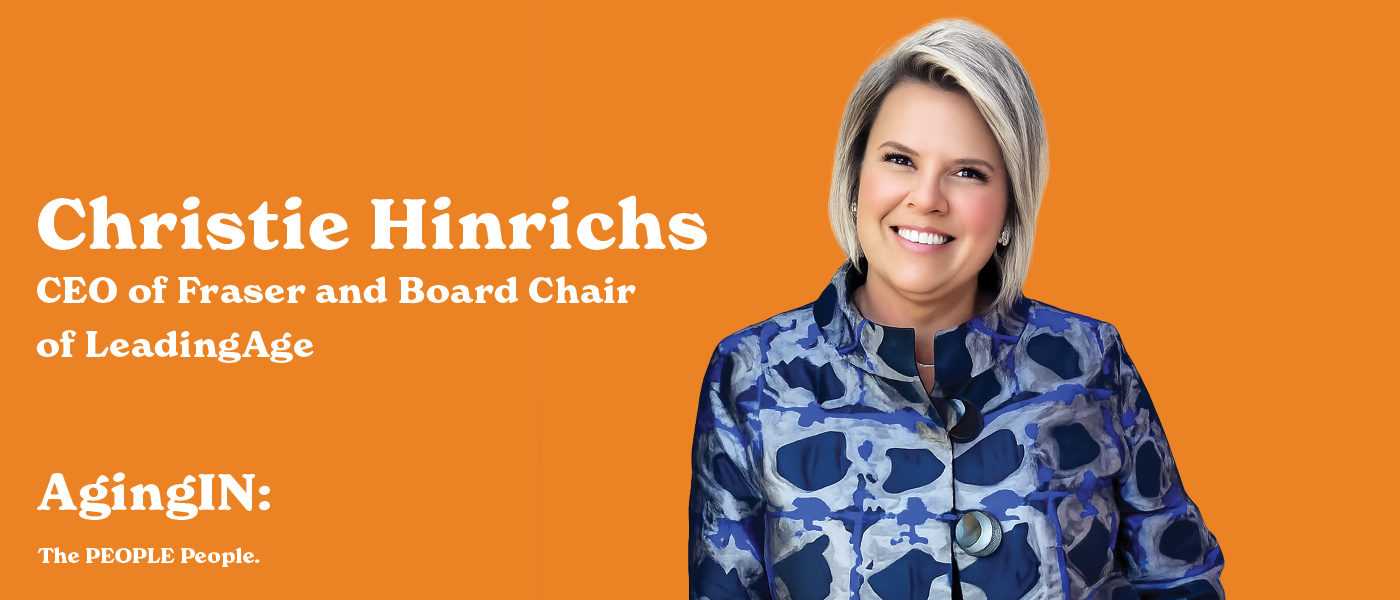
Christie Hinrichs’ path into aging services began long before her professional career. She grew up in a small town in Nebraska, where her family spent many weekends visiting older relatives and neighbors. Sometimes they visited family members. Other times, they visited people who had no nearby family and treated them like adopted grandparents. Hinrichs later recognized that these visits helped shape her understanding of loneliness and isolation among older adults.
Today, Hinrichs serves as CEO of Fraser in Boulder, Colorado and as Board Chair of LeadingAge. Throughout her career, she has focused on strengthening community, leadership, and support for older adults.
Discovering a Calling in Hospice Care
Hinrichs studied social work in college and initially planned to become a probation officer. While searching for work after graduation, she applied for a social work position in the hospice program at Tabitha in Lincoln, Nebraska. She later explained that she did not fully understand hospice when she first applied. However, the work quickly shaped her career and her leadership values.
Hinrichs spent about six months in direct social work before moving into leadership roles. Tabitha created a new position for herself as the organization’s first clinical coordinator who was not a nurse. She later became a hospice administrator and eventually led Tabitha’s private duty home care program.
Hospice work had a lasting impact on her approach to leadership. Supporting people at the end of life required steadiness and resilience. Those experiences reinforced the importance of mission and values in guiding decisions.
Leading Innovation at Tabitha
Hinrichs spent many years at Tabitha and later returned to the organization after working for a specialty heart hospital. When she returned, she served as vice president, then chief operating officer, and later became CEO in 2010.
During her leadership at Tabitha, the organization explored new approaches to improving residents’ quality of life. One example involved the Green House Home model.
The first Green House Home opened shortly before Hinrichs returned to Tabitha. After observing early results, the organization expanded the model across additional campuses.
Hinrichs described several examples that showed how the model improved residents’ outcomes. Some residents arrived using feeding tubes but later began eating independently. Others who relied on wheelchairs regained enough mobility to move around their new environment more easily. These outcomes reinforced her belief that care environments influence health and independence.
Addressing Loneliness and Isolation
Hinrichs deepened her focus on loneliness among older adults while completing a master’s degree in organizational leadership with an emphasis on servant leadership. During her studies, she researched the effects of loneliness and isolation on aging populations. The research strengthened her commitment to building communities that keep older adults connected and engaged.
This work later inspired the development of an intergenerational community at Tabitha that opened in 2023. The community encourages interaction between different age groups and creates opportunities for connection. Hinrichs believes strong communities play a key role in supporting health and well-being as people age.
Leading Fraser’s Resident-Driven Community
Hinrichs later accepted the role of CEO at Fraser, a life plan community located in Boulder, Colorado. The community serves about 500 residents and includes independent living, assisted living, memory care, and skilled nursing services. Fraser currently has about 800 families on its waiting list and continues to expand its independent living residences.
Resident engagement stands out as one of Fraser’s defining characteristics. Residents frequently start their own programs and invite others to participate. For example, residents have created music rooms using donated instruments. Others launched brewing groups and woodworking programs. One woodworking group even organized a project to maintain wooden benches across the campus. Hinrichs says her role often involves creating space for residents to pursue their interests and inspire others.
Defining Fraser’s Core Values
When Hinrichs arrived at Fraser, she noticed that strong values guided everyday behavior even though the organization had not formally defined them.
She worked with leadership, the board, and residents to identify five core values:
- Fostering community
- Cultivating curiosity
- Being accountable
- Demonstrating respect
- Inspiring excellence
These values guide both residents and team members across the community. Hinrichs also emphasizes transparency. Fraser shares information about finances, strategic planning, and operations with residents to strengthen trust and accountability.
Addressing Workforce Challenges Through LeadingAge
In addition to her role at Fraser, Hinrichs serves as Board Chair of LeadingAge, the national association representing nonprofit aging services organizations. She joined the LeadingAge board in 2015 and has watched the field prepare for demographic changes as the baby boomer generation ages. One of the biggest challenges facing aging services today involves workforce availability. The number of older adults who need support continues to grow, while the number of available caregivers may not keep pace.
Hinrichs believes the field must explore new workforce strategies. She suggests that organizations may need to recruit workers from industries affected by automation and technology, including individuals who may not have previously considered careers in health care. She also emphasizes collaboration across organizations so that leaders can share ideas and learn from existing solutions.
A Shared Responsibility for Aging
Hinrichs believes communities will play an increasingly important role in supporting older adults in the future. Not everyone will move into a senior living community, and the number of paid caregivers may not meet future demand. Families, neighbors, and community members will need to help support aging adults.
She encourages people to view aging as a shared experience. If individuals live long enough, they will eventually become part of that journey themselves.
A Simple Call to Action
Hinrichs offers a simple message: be present.
People can express their presence in many ways. They can offer support to neighbors, advocate for someone who cannot advocate for themselves, or participate actively in community life. Hinrichs believes communities can address the challenges of aging more effectively when people choose to support one another.