
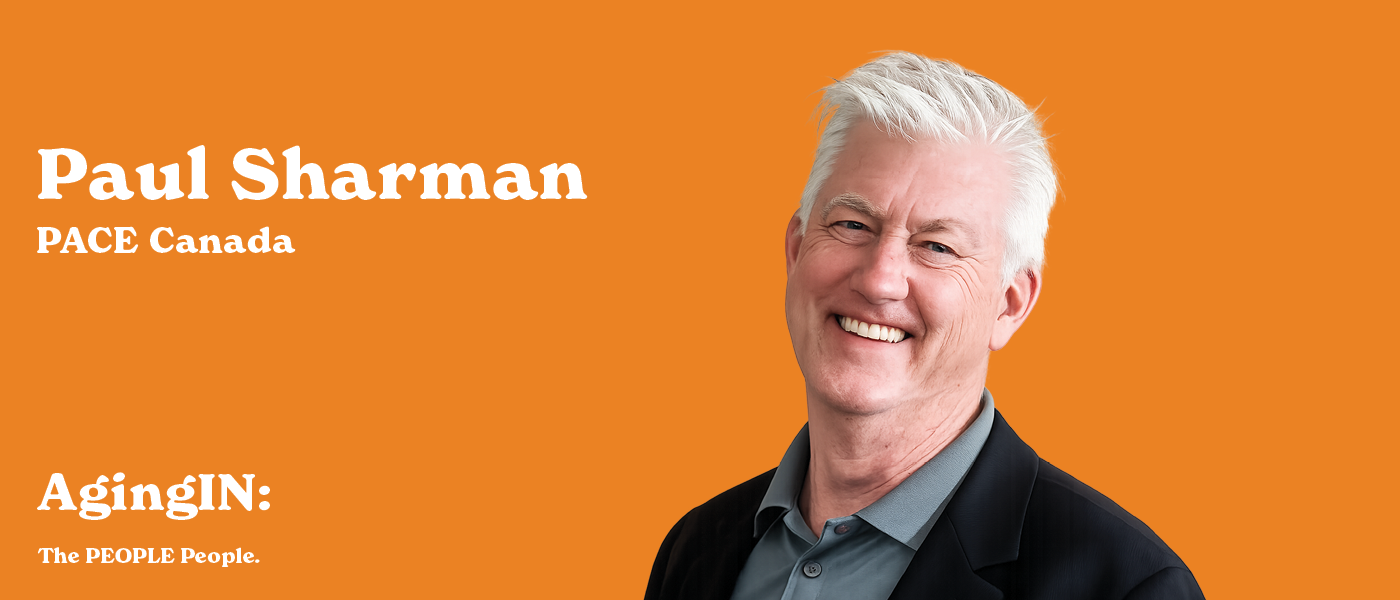
Paul Sharman has a story he likes to tell about his mother.
When Paul was five or six years old, riding home in the car, he turned to his mother and announced that he loved everyone in the world. She thought about it for a moment and replied, “Paul, that’s a little ambitious.”
It is the kind of story that feels like a key. In a recent episode of the Elevate Eldercare podcast, Sharman unpacked a career that moved from engineering to management accounting to international consulting to city council in Burlington, Ontario, and then, after his mother developed cognitive impairments, into a full-scale effort to transform how older adults are supported in their own communities. The through line, he says, has always been people.
A Career That Kept Turning Toward Others
Sharman built a distinguished career as a management accountant working with major corporations including Nortel and Levi Strauss. He became one of the leading specialists in activity-based costing, consulted with organizations around the world, and served as president and CEO of the Institute of Management Accountants. He was, by any measure, at the top of his field.
Then the 2008 financial crisis landed the day after he launched a new consulting firm, wiping out his target market overnight. He moved back to Canada, slowed down for the first time in years, and a year and a half later accepted an invitation from his city’s mayor to run for council. Sixteen years later, he is still serving.
What His Mother’s Experience Changed
Around 2010, Sharman’s mother began showing signs of brain change. The family struggled to find help that addressed what was clearly not a physical problem. They eventually saw a gerontologist who prescribed antipsychotic medications. Two days later, she was catatonic. It took six months to bring her back.
The experience became a turning point. Sharman began reading about social determinants of health, the idea that well-being is shaped as much by connection, environment, and purpose as by clinical intervention. A later trip to India introduced him to self-help groups, small community networks that pooled resources and support to create meaningful change from the ground up.
He came home with a different set of questions.
The Visit That Made It Real
In August 2017, Sharman traveled to Thome Rivertown in Detroit, Michigan, with Burlington’s mayor and a small group of colleagues. What he saw was a revelation: higher-needs older adults living in their own homes, supported by an integrated network of services that addressed every dimension of their lives, not just their medical needs. The people living there were visibly engaged, and the outcomes backed up what he was seeing.
On the drive home, his colleague turned to him and asked, “Should we do PACE?”
“Yes,” he said. “Absolutely.”
PACE, short for Program of All-inclusive Care for the Elderly, is a federally recognized model in the U.S. that integrates medical, behavioral, and community-based services for older adults aging at home. Rather than moving people into new settings, PACE coordinates an interdisciplinary team around each individual, covering everything from primary care to transportation to daily activities.
Building Something Together
Within months, Sharman organized a meeting of 80 community leaders in Burlington. He made one deliberate choice: no politicians. He wanted people who could commit to action without the weight of bureaucratic process. By the end of the evening, 10 leaders had agreed to form a committee, including the president and chairman of the local hospital, the commissioner of social services, the director of community housing, and a physician who was also a community developer.
The group spent the next year and a half designing the model together. In 2019, they launched a pilot project in community housing buildings, working with older adults who were upstream of crisis rather than already in long-term care settings.
Results That Are Hard to Ignore
The pilot produced the outcomes Sharman had hoped for. Non-urgent emergency department visits dropped. Reliance on the broader healthcare system decreased. The Ontario government’s own analysis found that the PACE model, scaled to 100,000 people, would save $19 million per year.
PACE Canada now focuses on the 95 percent of older adults who live in community housing rather than institutional settings. These are people who, in Sharman’s words, currently have access to little more than Google when they need support. The integrated collaborative model gives them more benefits: trusted relationships, proactive care, and services that meet them where they already live.
A Vision for What Comes Next
Sharman’s goal is to connect between 500,000 and one million Canadians to this model over the next five to 10 years. Technology plays a central role in that vision. Predictive analytics and digital dashboards can identify people who are moving toward crisis before that crisis arrives, allowing for earlier intervention that is less disruptive and far less costly than emergency care.
He is also sharing what he has learned with audiences in the United States. Sharman is scheduled to speak at the 2026 AgingIN Conference in Denver, Colorado, where he will share the PACE Canada model with aging services leaders looking for practical, scalable solutions.
For Sharman, the work connects directly back to that story about a five-year-old boy with outsized ambitions. Systems change when people with the right skills decide to put those skills toward the right problems. PACE Canada is proof that integrated, community-based support is not an ideal. It is a practice. And it is working.