
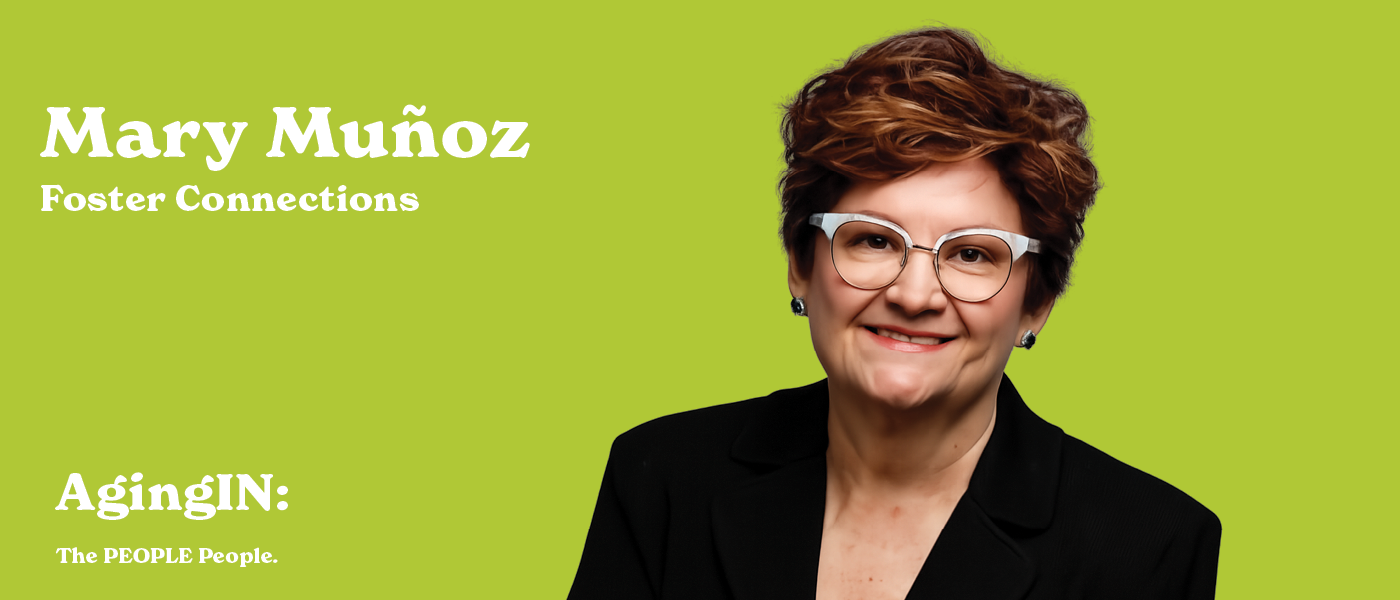
In February 2023, while walking past her favorite airport shop, a small, black card caught the eye of Mary Munoz. In white script on a black square, it read, “And suddenly…it’s time to start something new and trust the magic of beginnings.” The words cut straight to her soul. After nearly 40 years in healthcare and older adult living finance, she knew it was time to retire, not to escape work but to move toward the work her whole life had been preparing her for.
In the months that followed, Mary turned that sense of calling into Foster Connections, a nonprofit she described on the Elevate Eldercare podcast as the place where three threads finally came together: her own story, her belief in intergenerational living, and her decades in aging services. Centered on older adult communities and foster youths aging out of care, Foster Connections rests on the idea that these two groups have far more to offer each other than either realizes.
A Difficult Beginning
Mary grew up in Atlanta, Georgia, and Auburn, Alabama, in a home marked by domestic violence, mental illness, and long stretches of instability. Her mother, later diagnosed with schizophrenia, self‑medicated with alcohol. Her father, who was bipolar but highly functional and professionally successful, deeply valued education. When he left the family when Mary was 11, everything collapsed.
What kept her moving forward was a combination of grit and the kindness of people who showed up at exactly the right time. A woman she babysat for paid her four times the going rate. Her high school music teacher closed her office door one day and gently asked what was really happening at home. She found a safe social group through Campus Crusade for Christ. Looking back, she describes these connections as a “divine safety net,” and a series of “angels” who saw her, lifted her, and helped her imagine a different future. Those early lifelines inspired the formation of Foster Connections.
A Career Built in Finance
Convinced the classroom would be her path, Mary originally planned to teach high school English and earned a degree in English literature. However, a candid conversation with a beloved teacher about pay and prospects made her rethink that plan. Realizing she needed a more sustainable career, she pivoted toward business, which was a male-dominated industry in the late 1980s. Mary ultimately spent more than two decades at Ziegler, helping nonprofit older adult living organizations navigate complex financial decisions. Over time, her role evolved from doing deals to advising, teaching, and speaking about national trends. The work became deeply relational, and she realized that, in a different way, she had become the teacher she always hoped to be.
Seeing the Problem from the Inside
As her vantage point widened, so did her awareness of the deeper issues facing the field. She saw the same concerns recurring across organizations: struggling to find and retain staff, rising loneliness and mental health challenges for both young people and older adults, shifting demographics, and a broader breakdown of community.
At the same time, she kept thinking about young people, like the girl she once was, who were at risk, often on their own, and too easily failed by systems meant to protect them. She also learned that a high proportion of people on death row had histories in foster care, a statistic that deeply troubled her.
She also knew that older adult living communities [JW4] could be an engine of opportunity. She had seen people start in entry-level jobs and rise to leadership. She began to ask what might be possible if these places became part of the safety net for foster youth, offering not only a first job but also a sense of belonging. This question became the seed of Foster Connections.
Foster Connections Takes Root at Glencroft
An early answer emerged at Glencroft, a modern aging community in Glendale, Arizona. They had several two-bedroom casitas and wanted to explore using them for foster youths. Mary founded Thrive Arizona, a foster services provider that offers wraparound support, including education, mental health care, wellness services, transportation, and life skills coaching.
Bringing Glencroft and Thrive together, they designed a pilot in which foster youths live in designated on-campus apartments at reduced rent while working as employees. Thrive screens and selects participants who are ready for the opportunity, manages a membership structure for the units that complies with fair housing rules, and continues to provide resources, while Glencroft staff receive trauma-informed training.
The early outcomes have been promising. According to Glencroft’s CEO, the foster youths in the program have quickly become some of the most reliable employees on campus, while also building meaningful mentorships and everyday connections with older adult residents.
Building Toward Something Larger
This fall, Foster Connections is piloting a new initiative with 3G Mentoring, a nonprofit founded by a former executive producer of Sesame Street. The model brings together a young child, a high school or college-aged youth, and an older adult in a structured triad that meets weekly for eight weeks. Stanford’s Center on Longevity is following the work. True to Mary’s philosophy, the goal is for foster youths to help lead the program rather than simply participate.
Design is also part of the vision. Leslie Moldow, an architect at Perkins Eastman and a member of the Foster Connections board, worked with her students to design a prototype apartment building intended to house roughly 80 percent older adults and 20 percent at‑risk youths. The blueprint is intended to be shared freely with any organization interested in adapting the model.
What She Hopes For
Mary believes the older adult living sector is uniquely positioned to make a meaningful impact on a generation of young people who have too often been overlooked and underserved. In return, those young people can bring energy, companionship, and purpose to communities where many older adults long for the same things.
Her call to action is to look outside yourself. Notice who is within your reach, on your campus, in your neighborhood, in your orbit. Ask how you might become part of someone else’s “divine safety net.”