
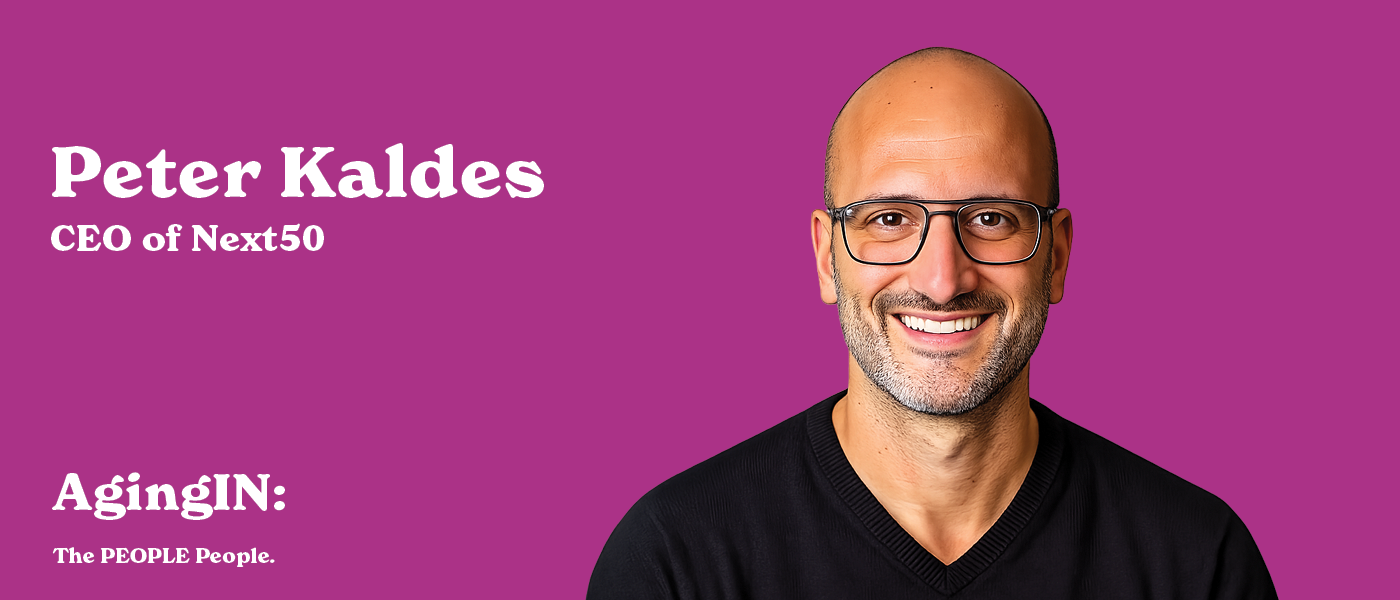
Peter Kaldes will turn 50 in two months, and he is not interested in pretending otherwise. He believes the reluctance to claim our own age holds the whole conversation back, since the only alternative to growing older is one nobody actually wants. So he says the number out loud and builds his work around a conviction that follows from it.
“Aging isn’t a crisis to manage,” he told Susan Ryan on a recent episode of Elevate Eldercare. “It’s the greatest opportunity of our lifetimes.”
As CEO of Next50, a Denver-based foundation, Kaldes is in an unusual position to back that belief with money. His journey to that role was far from linear. He began his career as a lawyer, worked on Capitol Hill, served in the Obama White House, and then moved into philanthropy at a major bank before ultimately leading aging-focused nonprofits, most recently the American Society on Aging. The unifying theme throughout was a pull toward impact and a growing recognition that the work was personal. “I want to make sure that when I turn 80, we have the resources we need to age well,” he states.
Next50 itself was born from a moment of transition. It formed in 2016 from the proceeds of the sale of InnovAge, another Denver organization, making it what the field terms a “healthcare conversion foundation.” Written directly into its mission is a commitment to serving older adults with low and middle incomes. A decade in, and the foundation holds an endowment of nearly $300 million and has given out around $90 million. It funds work in digital literacy, aging in place, and social inclusion, all in service of a larger aim to end ageism.
What Philanthropy Can Actually Do
Kaldes notes that only one to two percent of all philanthropic dollars in the country flow toward aging, and no amount of private giving can fill the gap left when public funding shrinks. What philanthropy can do is be catalytic, putting in a penny to attract more dollars and absorbing the kinds of risks that government and business often cannot.
That belief shapes what Next50 funds. Rather than sustaining only existing systems, it invests in helping organizations grow stronger and work together through:
- Software that nonprofits build themselves, because the tech industry has overlooked them
- Mergers and joint ventures, so competing groups can reach economies of scale
- Strategic planning, legal review, and the unglamorous work of capacity-building
- Training for people expanding the services their communities depend on
He believes that if we expect nonprofits to operate like businesses, we must remember that businesses carry overhead, and overhead needs funding too.
Why Aging Has to Be Personal
Kaldes formed a stronger emotional connection to his work when he lost his father to stage four pancreatic cancer. For more than three years, his father moved through a string of specialists, telling a gastroenterologist about his stomach, an orthopedist about his back, and a dermatologist about his skin. Looked at together, those were all symptoms of the same disease, but the burden of connecting the dots fell on his father, who effectively had to arrive at his own diagnosis and bring it to his doctor.
Kaldes had spent years working in aging by then, and even he found the system nearly impossible to navigate as his father’s advocate. If someone with his training struggled this much, the people without those advantages face something far worse. Aging, he argues, cannot remain as something that happens to other people. Until each of us sees ourselves in it, the systems that fail us will not change.
Investing in the World We Will Live In
Kaldes pushes back firmly against the “silver tsunami” framing, in which an aging population is considered a wave of devastation bearing down on society. Within a few decades, much of the planet will have more people over 65 than under 18. He would rather treat that reality as a map for where to build.
Through an effort called the Aging Investment Roadmap, developed with partners including JPMorgan Chase, Next50 makes the case that aging well takes more than good medicine. It takes everything people need to live full lives, and capital can flow toward all of it, including:
- Housing, such as multi-generational models that mix ages under one roof
- Jobs and real economic participation later in life
- Transportation and an environment designed for how people actually move
- Social inclusion, so that no one ages in isolation
One example he loves involves universities running short on students as birth rates fall, leaving dorm rooms empty. Older adults want to keep learning and need affordable housing, so pairing the two on campus turns two problems into one solution, pulling people back into shared life across generations.
The Future Is Old
To change the culture rather than just fund it, Kaldes launched a podcast called The Future Is Old, co-hosted with a colleague three decades his junior, so their generational differences play out on the mic. The show is playful and pointed, aimed at the cultural walls that keep us from accepting an aging society. Its first guest was anti-ageism advocate Ashton Applewhite, and it leans into the idea that the word “old” carries no shame at all.
Kaldes’s call to action comes in three parts:
- Stop making fun of your own aging, because real change starts with each of us before it can reach any system
- Give generously to the community organizations doing the work close to home
- And tell elected officials, loudly and often, that this matters
“The future is old,” he emphasizes. “And it’s ours to design.”
Listen to the full conversation with Peter Kaldes on Elevate Eldercare, available on Spotify and Apple Podcasts.