
Sometimes the most interesting people who specialize in aging and wellness aren’t the ones who followed a straight path. They’re the ones who zig-zagged their way to that big idea.
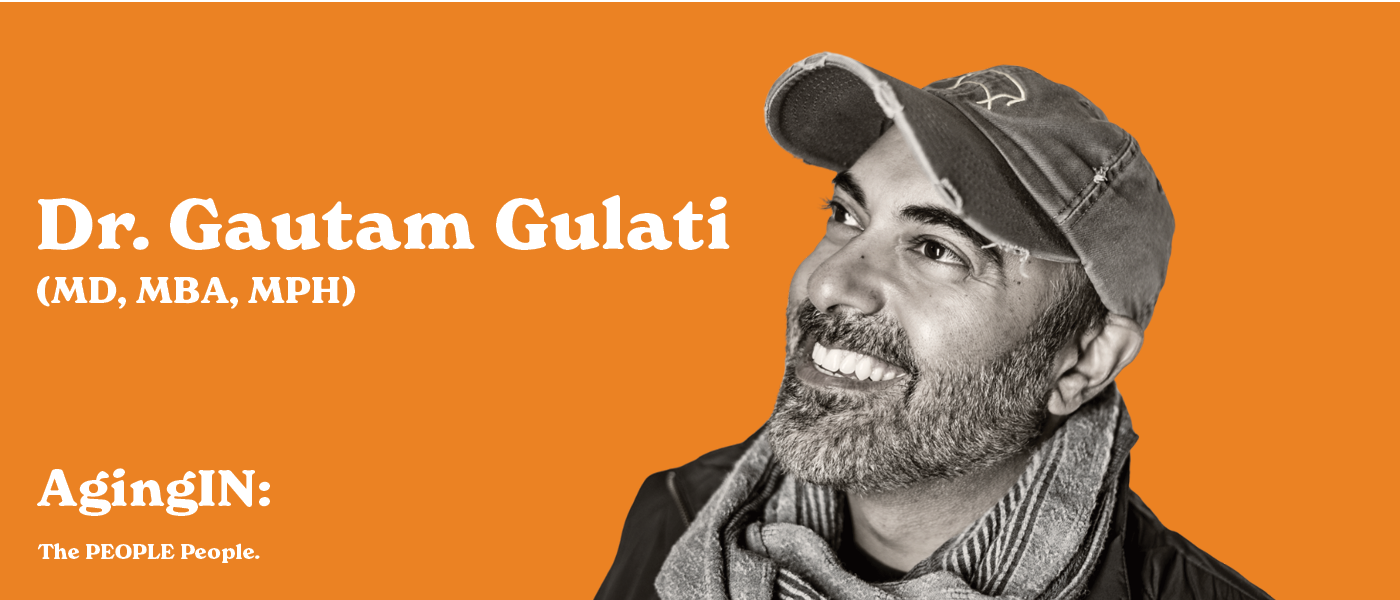
In a recent conversation, Susan Ryan, CEO of AgingIN, sat down with Dr. Gautam Gulati (MD, MBA, MPH), better known as Dr. G, aka “The Status Quo Agitator.” And that nickname isn’t just branding. Dr. G’s career has been built on challenging systems, questioning assumptions, and pushing the boundaries of what healthcare and wellness can look like.
He’s a doctor, entrepreneur, innovation executive, investor, professor, writer, and self-described “health artist.” He’s also an award-winning storyteller and keynote speaker who helps leaders rethink creativity, innovation, and the future of health.
But what made this conversation stand out wasn’t just his resumé. It was his core message: your home may be one of the most powerful (and overlooked) tools for health. Not your supplements, not your wearable, not your next wellness trend. Your home.
A Career Built on Curiosity (and Storytelling)
Susan opened the conversation by asking Dr. G about his journey, because it’s not every day you meet a physician who’s also deeply involved in real estate and interior design.
Dr. G was honest: his career wasn’t linear, and he couldn’t have predicted where he’d land 10 years ago. But looking back, he said the dots connected around one consistent theme: storytelling. He described himself as someone who helps people shift their story from what it is today to something better tomorrow. In positive psychology, that’s known as self-authorship.
That focus on lived experience started young. Before real estate apps such as Zillow existed, Dr. G spent Sundays with his dad flipping through the newspaper’s real estate section. They’d circle listings, hop in the car, and drive around imagining what each property could become. They weren’t drawn to perfect homes. They were drawn to fixer-uppers—spaces that needed a second chance.
Without realizing it, Dr. G was developing the same mindset he’d later apply to healthcare: how to take something outdated or broken and redesign it into something better.
Alzheimer’s Changed Everything
In 2012, Dr. G’s father was diagnosed with Alzheimer’s. As a family full of doctors, they pursued the best specialists, the best facilities, and the best medical interventions. But over time, his father’s condition declined. Eventually, his parents moved in with Dr. G and his family.
That’s when Dr. G began noticing something unexpected. The biggest shifts in his father’s quality of life weren’t coming from prescriptions or devices. They were coming from the environment: lighting, layout, noise levels, patterns, color, routines, familiarity, and safety. The home was either helping his father function or making symptoms like confusion, sundowning, and agitation worse.
Dr. G turned to research and quickly realized there was no clear playbook for how to design a home around dementia care, even though millions of families were living through it. So he started asking questions.He spoke with architects, academics, building experts, healthy materials researchers, and practitioners. Over time, he pieced together insights from these different fields and began developing home-based design protocols with a focus on dementia support.
The results were dramatic. Dr. G shared that through environmental adjustments alone, his father went from taking 12 medications down to three, with an improved quality of life toward the end of his life. His father passed away in 2017, but the lesson stayed with him and raised an even bigger question: if design can influence dementia symptoms this much, what else can it influence?
Dr. G’s Health Started to Slip Too
Around the same time, Dr. G was entering a phase many in the sandwich generation know well: career pressure, young kids, aging parents, nonstop responsibilities. His own health took a hit. He gained around 40 pounds, became pre-diabetic, and was borderline hypertensive. This resulted in metabolic issues, inflammation, gut problems, joint injuries, and even hearing loss.
Instead of approaching his health only through traditional medical fixes, he applied the same concept he used with his father to himself. What if I change my environment to change my habits? In coaching and design circles, this is often called “shaping the path”—designing your environment to be simple, supportive, and natural for you.
Within about a year and a half, he said he reversed nearly all of his health issues. That was the moment the concept became impossible to ignore: the home isn’t just where health happens. The home directly shapes health.
The Well Home and the Seven Levers of Bioharmony
Today, Dr. G’s work lives inside a concept called “The Well Home,” a company focused on designing spaces optimized for health, longevity, and well-being across luxury homes, hospitality environments, wellness resorts, and senior living communities.
To make wellness design feel more approachable, Dr. G developed a framework called “The Seven Levers of Bioharmony: Sleep, Movement, Nutrition, Mindfulness, Connection, Purpose, and Safety.”
He calls them levers because they’re adjustable, not all-or-nothing. And they don’t work independently—they work together like instruments in a band. According to Dr. G, these levers can become the foundation for health or the foundation for disease, depending on how well they’re supported. The goal isn’t perfection in one of those categories; it’s finding balance and harmony between both.
Even better, he believes these levers can be designed into a home so that healthier living becomes easier by default.
Practical Changes That Actually Move the Needle
Dr. G shared a few examples of how homes can support longevity without requiring a massive renovation.
Sleep: Dr. G mentioned the importance of getting sufficient sleep, and believes that sleep begins the moment you wake up. Your circadian rhythm depends on exposure to natural light, but artificial lighting can confuse your body’s cortisol and melatonin cycles, which affects sleep quality. Dr. G suggests getting daylight early in the day, even if it’s just standing by a window while drinking coffee. He also recommended circadian lighting systems that shift from cooler light in the morning to warmer light in the evening.
Air and water: Dr. G said some of the biggest health disruptors in the home are invisible. Modern homes tend to trap air inside, along with many chemicals from items we are exposed to every day, such as paint, rugs, furniture, flooring, cleaning products, and fabrics. He recommended higher-quality air filtration (ideally MERV 13 or higher) or medical-grade air filters in high-traffic areas like bedrooms and kitchens. For drinking water, he suggested reverse osmosis filtration.
Connection: One of his most relatable points was about device usage. He said that constant device use creates “dopamine fatigue,” a condition that can make it harder for individuals to choose physical connection over virtual connection. His recommendation to offset this is to redesign an underused room into a tech-free gathering space, which he calls a “social speakeasy”—a cozy lounge that feels like your favorite café or hotel lobby, where actual conversation becomes center stage.
Dr. G emphasized that connection and purpose are two of the strongest drivers of longevity, and your home can either support them or quietly sabotage them.
How AI Fits In
Dr. G also shared how The Well Home is using technology and AI to scale its work. A full home assessment usually requires hours of observation, documentation, and reporting, which can become expensive. To reduce that burden, the team built an AI-powered process that generates a customized report based on a voice-transcribed home walkthrough.
Their AI pulls from a knowledge base tied to the seven levers and turns the information into a structured evaluation and score. The goal is to automate the heavy lifting so the human part—conversation and recommendations—can become the focus. This process is called a Bioharmony Home Assessment, also referred to as a Healthy Home Makeover.
Your Genes Aren’t Your Destiny
Susan asked where science fits into this work, and Dr. G highlighted his ideas based on epigenetics. He explained,e “Your DNA is the hardware, but your epigenetics is the software.” Lifestyle can influence outcomes; your biography becomes your biology.
And what influences the “software” the most? Dr. G says that it’s the same seven levers: sleep, movement, nutrition, mindfulness, connection, purpose, and safety.
He also offered a grounded reminder that many popular longevity trends (e.g., peptides, stem cells, red light therapy, hyperbaric oxygen therapy) may have promise, but they aren’t all fully proven, regulated, or risk-free. His approach is more middle-of-the-road risk-benefit thinking and avoiding extremes.
The Future: Homes as Therapeutic Systems
Susan asked where he hopes wellness and longevity will be in the next five to 10 years, and Dr. G answered with his vision of therapeutic systems. That is, he believes our environments will evolve from shelter and comfort into therapeutic systems, which is a more intentional style of living.
We spend most of our lives indoors, and much of that time is spent at home. If the home shapes our habits and biology, Dr. G argues it makes sense to design it with the same care we put into other health decisions.
A Simple Call to Action
Dr. G ended with a challenge for the audience: start with awareness. Look around your home through the lens of the Seven Levers of Bioharmony. Is your environment helping you sleep, move, eat well, connect, and feel safe? Or is it quietly working against you?
Because health doesn’t happen in a vacuum.
It happens in the spaces we live in.And if we want a different future, we may need to start with the walls around us.