
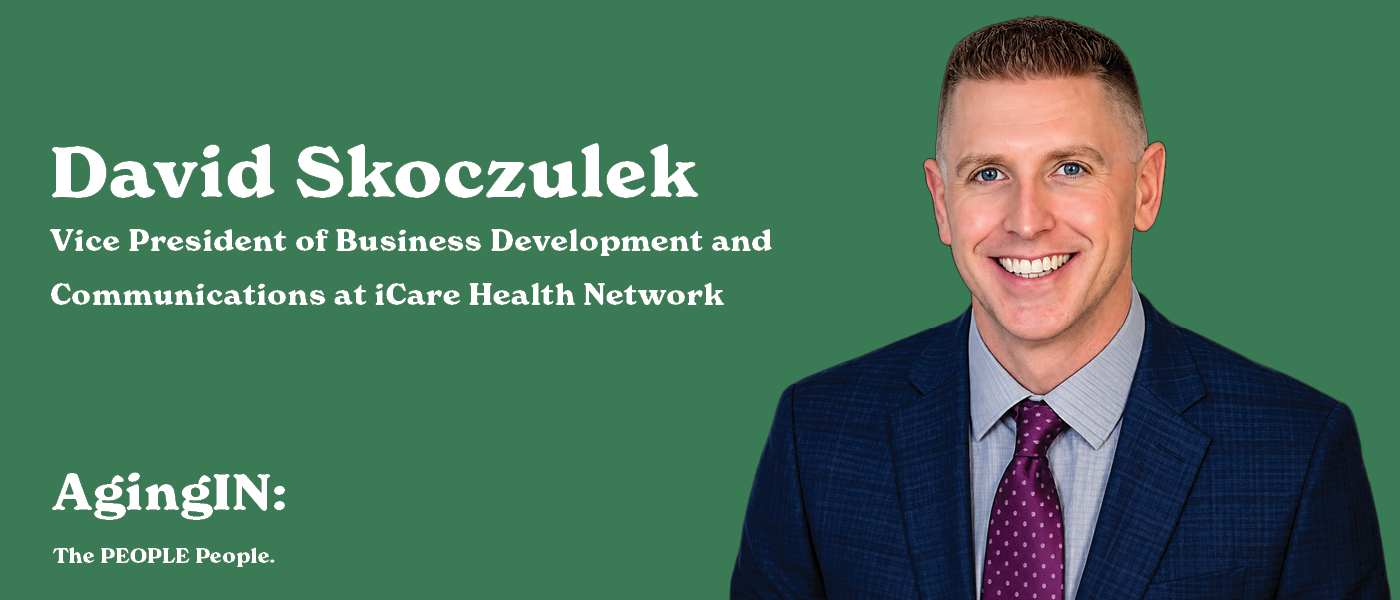
David Skoczulek was about 20 years old, a brand-new EMT transporting an older gentleman living with brain change, when the man began grabbing at him, confused and increasingly agitated. Skoczulek tried to talk him through it, saying, “We’re almost there…you’re doing fine…this is what’s happening.” The escalation continued for several minutes before he realized the man was scared and simply wanted his hand held. The moment Skoczulek took his hand, the fear drained away.
He has run somewhere around 5,000 calls since, and that one still shapes how he trains new paramedics. He teaches that the tools come second; the job requires connection first.
This connection-first approach carried him through nearly two decades in emergency medical services, where half or more of the calls involved older adults, into his role as Vice President of Business Development and Communications at iCare Health Network. The Connecticut-based organization operates 12 residences across three New England states. And he still practices as a paramedic one shift a week. He shared his story with Susan Ryan on a recent episode of Elevate Eldercare.
Built for the People Others Turn Away
When iCare’s founders purchased their first buildings out of receivership in the late 1990s, they sought to understand Connecticut’s primary needs. Conversations with the state and stakeholders repeatedly mentioned behavioral health, which became the company’s foundational focus. Twenty-seven years later, under the same ownership group and remarkably stable leadership, iCare has a reputation for specializing in complex and challenging cases. They handle anything from refractory heart failure requiring intensive clinical management to behavioral health, substance use disorder, HIV, and Huntington’s disease. These conditions are often layered with homelessness and a younger-than-average resident population concentrated in Connecticut’s cities.
The company’s admissions process reflects on the importance of getting placements right. Skoczulek oversees a team of seven nurses who see nearly every prospective resident in person, track cases over time, not making decisions from a single snapshot and follow up on referrals to confirm that a concerning behavior has been resolved.
The First of Its Kind in the Country
In 2012, the Governor’s office issued a request for proposals for a residency serving individuals in state custody who were difficult to place. iCare won the bid and, in 2013, opened 60 West in Rocky Hill, the first center of its kind in the country. Massachusetts and Vermont followed with their own programs, and the three centers now operate under a service line called MissionCare Health, each one somewhere between 30 and 50 percent justice-involved.
The people arriving from correction facilities come through formal release mechanisms, from end-of-sentence to medical and compassionate release. Skoczulek is careful to explain who they actually are. For example, a 60-year-old who has been incarcerated since age 18 often has the body of an 85-year-old and significant cognitive decline on top of a long list of diagnoses. Before anyone arrives, a nurse liaison has seen them inside the correctional environment, reviewed their records and infractions, spoken with their peers and clinicians, and confirmed they meet the federal requirements every resident must meet. The centers operate with no waivers or regulatory exceptions and are surveyed like any other.
What surprises people most is which residents settle in easiest. Decades of institutional living mean the people arriving from corrections typically integrate quickly and calmly, and staff often describe them as among the least complicated people they serve. The harder transitions tend to come from the other half of the population—people arriving from hospitals and behavioral health settings whose conditions are more dynamic. For those coming from prison, the work is often gentle deinstitutionalization, like learning that you can leave your room whenever you want.
Staffing a Mission
When 60 West opened, the company worried no one would apply. But a couple thousand people did. Some wanted a new challenge after years in traditional settings, some came from acute behavioral health, and many had a family member who had been through the correctional system or lived with stigma and wanted to be part of the answer. The deeper pattern at iCare is longevity workforce tenure. When the company marked its 25th anniversary, it counted roughly 210 employees who had been there more than 20 years.
Skoczulek attributes that culture to leadership, especially Founder Chris Wright, who led the company for 25 years and now chairs the American Health Care Association board. The results follow the residents into a demand that the company is trying to keep pace with.
- Both original MissionCare centers run at or near capacity with waiting lists.
- Skoczulek is in active conversations with 10 to 15 states at any given time.
- Correctional systems nationwide face rapidly aging populations, staffing shortages, and officers never trained to help frail older adults.
- Moving someone to this setting can cost a quarter of keeping them in corrections, and in a more humane and less restrictive environment.
“Let’s Tell the Thousand Stories”
Asked about his vision, Skoczulek returns to something he heard from the American Health Care Association’s president: a call for the whole field to reset its thinking. “People in long-term care in the nursing home industry are so used to being a pariah half the time,” he explains, we were so bashed during COVID,” he explained. “Let’s tell the thousand stories,” of good that happen every day, rather than letting the one bad story define everything. He would rather the field build places where people genuinely want to work and see regulators incentivize progress instead of only penalizing failure.
Lastly, his own answer to the skeptics who ask whether this population “deserves” to live in and receive what iCare provides has stayed the same for a decade. “First of all, our job is to take care of human beings, so we don’t make that determination. We operate in a stigma-free way, and we have a mission, and we’re going to accomplish that mission.”
Listen to the full conversation with David Skoczulek on Elevate Eldercare, available on Spotify and Apple Podcasts.