
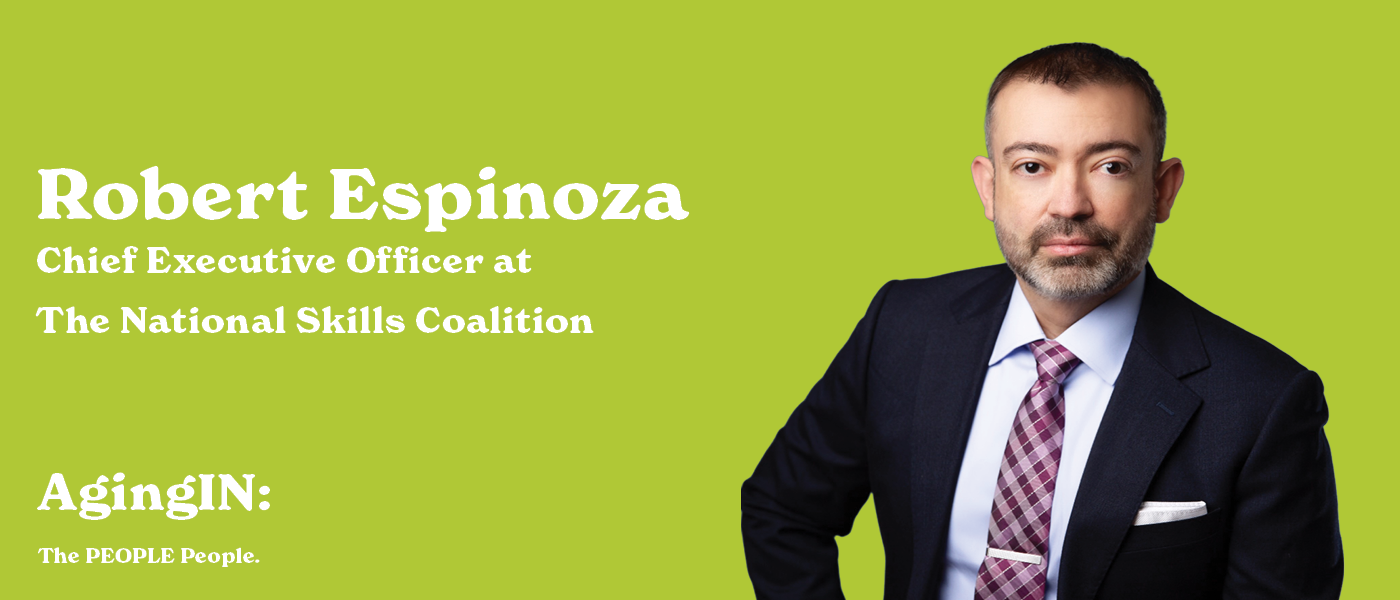
About 10 years ago, Robert Espinoza had a heart attack. In the months that followed, with his cognitive sharpness and physical capacity diminished, he needed a worker to come into his home and help. However, he was ruled ineligible by a technicality. Espinoza had spent years as a researcher and policy analyst who understood the long-term care system as well as almost anyone in the country, and it still failed him when he needed it most.
That experience, along with watching his aging parents hit a maze of roadblocks from 2,000 miles away, pinpointed the problem he’s spent his career trying to solve. He calls it the “caregiving divide,” and he explored it with Susan Ryan on a recent episode of Elevate Eldercare.
A Studio Built to Reimagine the System
Espinoza began his career in philanthropy supporting LGBTQ+ rights, and it bloomed from there. He spent five years at SAGE changing the narrative around LGBTQ+ older adults, then led the research and advocacy arm of PHI for nearly a decade. From this experience, he was able to see how negatively the people who do this kind of work are viewed by the public. They were portrayed in the news either as a point of dispute around federal policy issues regarding their wages or seen in mugshots with headlines painting them as villains of robbery and abuse. For a workforce rich with skill and dedication, those being the only two narratives were devastating.
As a result, Espinoza launched his own civic enterprise, the Care Works Project. It acts as an advisory and innovation studio that helps public and private leaders rethink the long-term care system for the way people live today. He credits his late mentor, the activist and author Urvashi Vaid, with the idea underneath it. She argued that “liberation [is] about not just accommodating yourself to the norms of what others have created, but to actually accommodate others to your norms.”
Naming the Divide
Espinoza developed the caregiving divide framework during a fellowship at the University of Chicago, and he defines it plainly as the gap between what people need and deserve and what they actually receive. One eye-opening instance in regards to this divide was when he suffered a heart attack. He learned:
- Resources: A year of in-home help can run 60,000 to 75,000 dollars, and a private room can cost well beyond many people’s retirement savings.
- Geography: What a person receives depends on their zip code, which can affect how far they have to travel or whether a worker trained in one state can work across the line in the next.
- Power: This pertains to who gets to decide how the system is designed, the investors and executives, or the workers and the people at home.
Espinoza gives an example of the impact of geography on the system. A worker can complete the best training program in New York, move five miles to Jersey City, and be required to retrain from scratch. It wastes resources, pushes good workers out of the field, and undermines the consistent help people want in their homes.
One Credential, Every State
Espinoza’s first major project targets the issue with geography. Working with PHI on the Universal Direct Care Workforce Initiative, he’s helping design a model where a worker’s training travels with them. The vision rests on four pillars:
- Standardized core competencies set at the federal level
- Portable and stackable credentials
- Real career pathways
- Training infrastructure to support those careers
PHI is already running demonstration projects in Wisconsin and other states to prove the model can be replicated and funded.
The team also gave the initiative a visual identity that captures the idea. Instead of a fragmented maze, the artwork shows a worker looking up at a constellation, like a connected set of points and pathways. Espinoza adds, “When a worker, like any of us, looks into the skies and dreams about the kind of career we want to have or the life we want to live, we should see a constellation that inspires us.”
Making Technology More Human, Not Less
His second project tackles a subject that most of the field has barely begun to study. Partnering with the National Council on Aging’s Direct Care Workforce Strategy Center, Espinoza wrote a three-part report series called A New Era of Care on how artificial intelligence is already moving through the home setting. It lays out what the technology entails, weighs common worker and agency responsibilities against real-world examples, and asks workers and experts themselves about the risks and the safeguards.
His perspective challenges the usual fears around new technology. He argues that, because these tools are already part of everyday life (e.g., smart pill dispensers that dispense medication on schedule or the intelligence built into smartphones), the real question is whether, with proper safeguards, they can actually make work more human. When a tool takes over routine tasks, it can free workers to focus on what machines can’t do, like solving complex problems, being physically present, and building the emotional connections at the heart of their jobs.
Change Is Local, Impact Is Global
Furthermore, Espinoza notes that none of this will work without the business community at the table alongside workforce advocates rather than across from them. And that collaboration requires a certain mindset shift, too.
Espinoza sits on the board of the Frameworks Institute, which recently studied how the public thinks about this work. People tended to see it as a personality trait rooted in compassion, something women are assumed to naturally possess, which quietly implies it’s not a real profession. But the promising finding was that people can grasp the systems behind it once those systems are properly explained.
Espinoza offers the following advice to anyone seeking a career in this field, or are currently in the middle of their own journey: “There’s no script to this; it’s not you, it’s the system. Take some relief. Know if you’re going through a situation like this…that there are definitely pathways, and it helps to reach out, and there are resources to support you. Understand that the system is deliberately, or maybe unintentionally, confusing and poorly designed…but you know you’ll find your way through it into something that feels right.”
Most importantly, he says, “Change is local, but impact is global.”
Hear more from Robert Espinoza on Elevate Eldercare, available on Spotify and Apple Podcasts.