
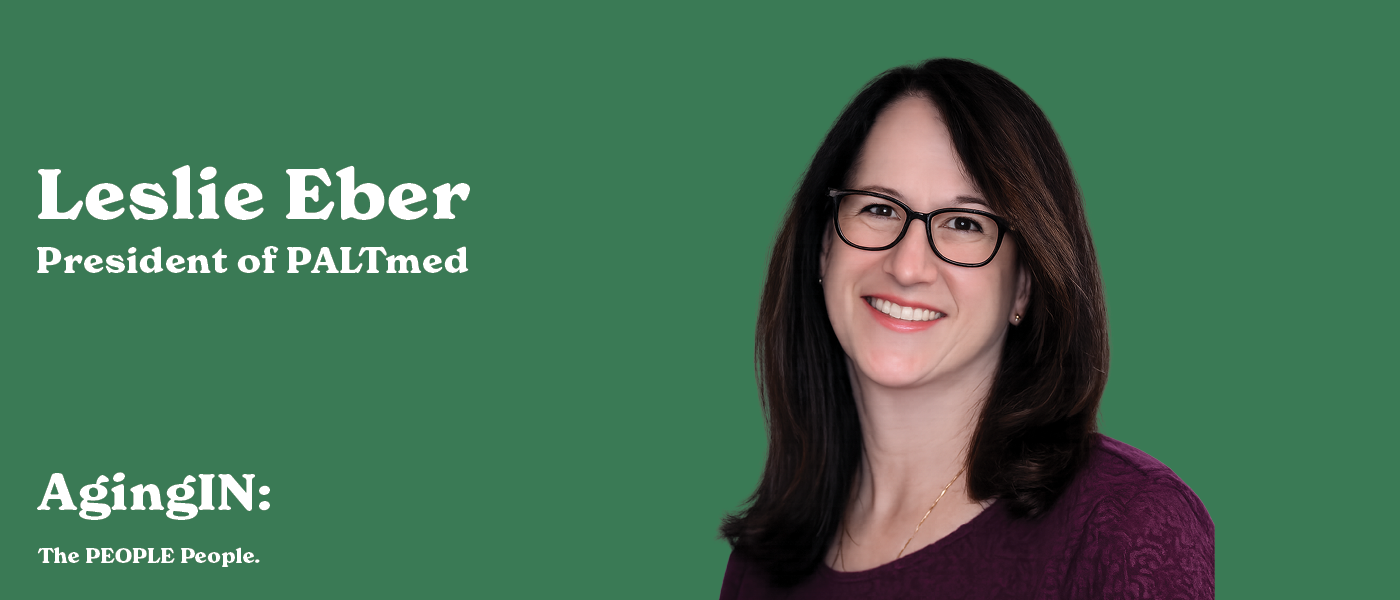
On Saturday mornings when Leslie Eber was growing up, she rode along with her father on his hospital rounds. He was an oral surgeon, and what stayed with her was the way he paired real skill with a genuine desire to help people. Afterward, the two of them would go for jelly donuts.
This childhood memory eventually grew into a professional calling. Eber began her career in internal medicine and outpatient practice, with a period of locum work during a season of personal change. Then Dr. Mike Wasserman offered her a position in post-acute and long-term care medicine. She was not sure what she was stepping into, but by the end of her first month, she knew she had found something special.
“I love walking into my [communities],” she told Susan Ryan on a recent episode of Elevate Elder Care. “It makes me feel like Cheers. When you walk in, everybody knows your name. You’re part of a community, and so it combines my desire for caring and for humanitarianism with a passion for science and medicine.” Twenty-one years into the work, she still describes it as a hidden gem.
The Medical Director as a Full Member of the Team
Eber serves as medical director for three communities, and she is fully present in each one. They are on her mind when she wakes up and when she falls asleep. Her work on any given resident often begins before she arrives. It starts with a whole-person medication review that asks whether anything might be clouding their thinking or affecting how they feel.
Her role continues to evolve once she steps inside the building. On some visits, she joins quality assurance meetings, where she has learned that the best ideas often come from those closest to daily operations. These are the people who notice the small details that a visiting physician might overlook. Another stop could bring her to a council meeting, where she hears firsthand from residents. And much of her time now involves education, a scope that expanded after COVID. Initially, she targeted clinical staff with her teaching, but now she includes residents, family members, dietary teams, and housekeeping alike.
She thinks of herself as one leg of a three-legged stool, sharing the weight with the director of nursing and the administrator while the resident sits on top. The structure only holds when trust runs through every leg of the team. That trust is what lets a CNA mention in the hallway that a resident’s sneakers are suddenly tight, a small detail that can be the first visible sign of a medical problem. Such observations only surface when people feel safe to share.
PALTmed and the Drive to Deprescribe
Eber is also the current president of PALTmed, the Post-Acute and Long-Term Care Medical Association, formerly known as AMDA. The group rebranded to reflect the full range of professionals it represents, including nurse practitioners, therapists, and dietitians, who all join as voting members alongside physicians.
PALTmed offers a range of tools and resources, including:
- Choosing Wisely, a 20-item quick reference on standards in post-acute settings
- Drive to Deprescribe, an interactive program on medication reduction, with a second step on building a deprescribing effort at the community level
- Webinars and symposiums throughout the year, including a coming series on AI in post-acute settings
- A members-only national forum for discussing what works and what does not
The Drive to Deprescribe was quickly embraced by both leadership and frontline teams. What Eber values most is how far past the physician it reaches. Nurses, aides, families, and residents all join the conversation about what medications a person truly needs, in what she calls an “all teach, all learn” spirit that keeps people coming back month after month.
What Empathy Does in Advanced Brain Change
Eber’s thinking around brain change is shaped by a finding that deeply resonated with her. She explains that even in its advanced stages, people can still receive empathy and kindness, and it reaches them whether they can say so. A familiar voice or a held hand still feels meaningful at the very end of life.
From there, she gets more practical. She urges every team to plan for tough moments, because it is hardest to think clearly once they are already happening. Her own first instinct is fresh air. A Colorado partnership focused on brain change recently released its “How You Respond Matters” card, small enough to tuck behind a name badge. It reminds people of something to reach for when things escalate, whether that is music, a snack, a walk outside, or a purposeful activity.
Listening as the Foundation
Over time, Eber discovered that culture is defined most powerfully by listening, especially to the people no one thinks to ask. Housekeeping staff catch things nobody else does, and aides spend more hours beside each resident than anyone else on the team. When those observations reach the room where decisions are made, and people feel heard, buy-in follows naturally, and the work grows lighter.
“Inviting everybody to the table makes it so much of a richer conversation,” she said.
Her hopes for the field continue to expand. She wants these communities woven into ordinary life rather than set apart from it, so they are more connected across generations and less defined by age. Pushing back on ageism, she believes, is work anyone can take up, and it starts with the conversations that are easiest to skip. The wisdom is already there waiting.
“Don’t let that opportunity pass you by.”