
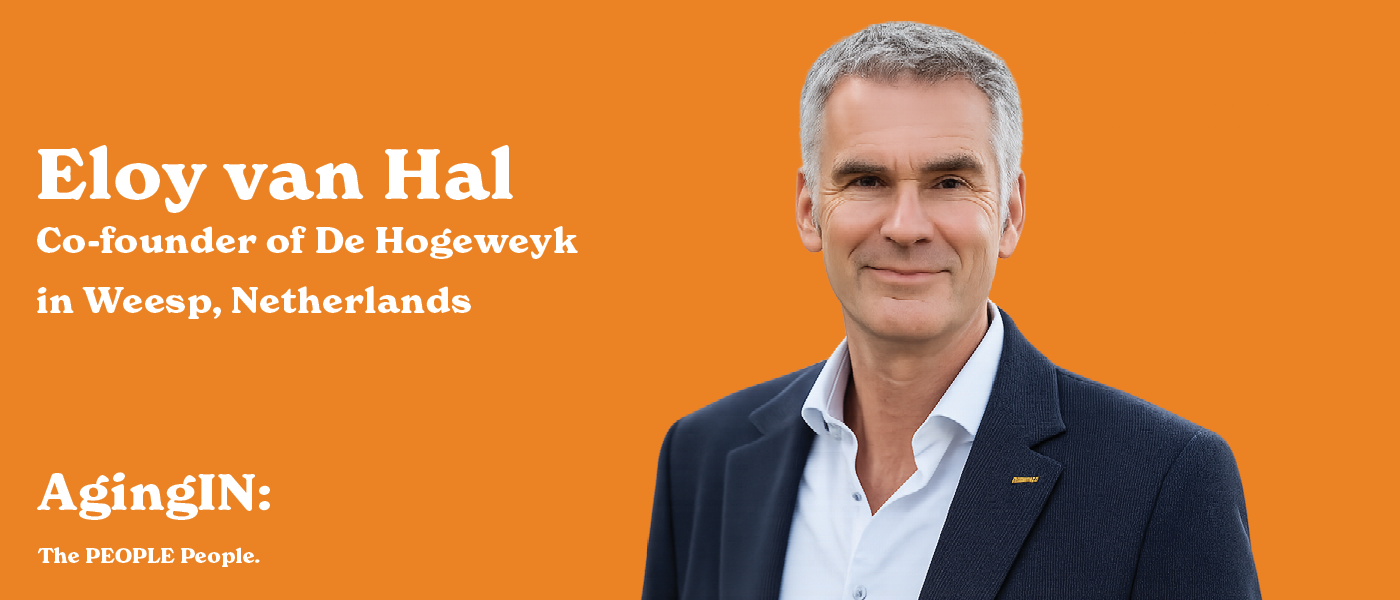
When an old institutional home was demolished, family members of residents told Eloy van Hal they would miss it. He could not understand the nostalgia. He was fed up with that building for years, with its long wards and tired routines built around staff efficiency rather than the humans living inside it. Still, he came to recognize that the families were really mourning something that had nothing to do with the bricks.
That insight sits at the center of what van Hal told Susan Ryan on a recent episode of Elevate Elder Care. As a co-founder of De Hogeweyk in Weesp, Netherlands, van Hal has spent more than two decades reimagining what life can look like for people living with dementia. The Hogeweyk is now an internationally recognized model of community-based memory support, drawing visitors from 55 countries. They’ve come to learn how small homes, each housing a handful of residents, have changed the conversation. Through it all, van Hal kept returning to the same idea that buildings are easier to redesign than mindsets, and the mindset is what actually changes a person’s experience of aging.
Normal Daily Life, even in the Wrong Building
Long before any new walls went up, van Hal and his colleague Jannette Spiering were already running the experiment that would become The Hogeweyk. Working in a traditional skilled-services home with 33 people on a single ward, they divided the wards into smaller living groups of 11. One nursing station became a kitchen for the new layout, while mobile kitchens were rolled into the other living areas at dinnertime. A small basement supermarket gave residents somewhere to go, and they ended up socializing while standing in line for the elevator.
None of this required an innovation budget. Most of the furniture was second-hand or donated, and the staff painted the rooms themselves. What changed was the question being asked, not the spending. Instead of asking how to keep people safe inside a building, the team started asking how to help people keep living life to the fullest.
The results showed up almost immediately. Residents grew calmer and more engaged, and friendships formed between people who had previously kept to themselves. Staff noticed it first, and family members were not far behind.
A Neighborhood Instead of a Ward
When the old structure was finally demolished, the team built something different in its place. The new design grouped residents into households of six or seven, each with its own front door opening onto a real street. People were matched to households based on lifestyle preferences rather than diagnosis, so the comfort of familiar tastes and rhythms was felt from the moment someone moved in. The whole property functions as a neighborhood, with cafés, a theater, a supermarket, gardens, and courtyards where residents move freely indoors and out.
What looks like an architectural innovation is really a different theory of risk. In most institutional settings, staff are trained to prevent every possible incident. A knife disappears from the counter, and a chair gets positioned so the resident sitting in it cannot easily stand up alone. Each precaution feels reasonable in isolation, but taken together, they remove the texture of being alive along with the danger. At The Hogeweyk, the working principle is the opposite. Staff observe before intervening, and they trust residents to keep doing what they can, accepting small risks as part of a meaningful day.
A Different Conversation About Medicine
Some of the most striking numbers van Hal shared concerned medication. When older adults move into The Hogeweyk, they are typically taking seven or eight different prescriptions. After review by the on-site physician, that number drops to an average of four. When van Hal asks American visitors what people in their communities are taking, the answers range from 12 to 25.
The difference reflects a national conversation about end-of-life healthcare that the Netherlands has been having for a long time, one focused on comfort, dignity, and acceptance rather than extension. Feeding tubes are rarely used, and hospital transfers are uncommon. Specialist physicians spend roughly half their time helping families understand what to expect as a person’s condition progresses, and what medical intervention can and cannot offer in the final phase of life. The honest conversation is itself part of the treatment.
Trust as a Staffing Model
This kind of work is only possible with well-prepared staff, and in the Netherlands, that means a three-year vocational education for on-site workers, not a two-week orientation. Each Hogeweyk household is run by a small, consistent team that knows the people they are helping. Every home plans its own weekly menu, built around what the residents living there actually want to eat. The team is responsible for everything from cooking and cleaning to managing medication, while inviting residents into the rhythm of the household rather than performing every task on their behalf.
Reading the Regulations Again
When leaders elsewhere claim regulations prevent them from taking The Hogeweyk’s approach, van Hal replies they haven’t reread the rules enough. In his experience, the written regulations often allow more than one might assume. The harder barrier is habit. To prove that small-scale household cooking could meet hygiene standards, for example, his team partnered with an outside lab for unannounced inspections to test surfaces, fridge temperatures, and the food itself. Reports came back every two months, the data made the case, and eventually, Dutch national regulation followed.
Today, through the small advisory team at Be Advice, van Hal supports organizations across Europe, North America, Asia, and Australia, working through that same kind of process. He continues to encourage organizations to build a vision rooted in the people you are serving and start with mindset before architecture.
A More Human Conversation
Asked what he hoped the next ten to 15 years would bring, van Hal returned to the same theme that opened the conversation: a human model. He is proud of the model’s worldwide spread, but even more proud of the larger movement that has grown around it. The future he described looked something like this:
- A global pivot away from the clinical model
- Wider acceptance of brain change as part of life
- Honest conversations about end-of-life services
- Communities where people are seen as humans first
He mentions that we cannot change the person, “so we have to change how we look at our loved one, [and] how we can support our loved one.”
That, for van Hal, is where life with cognitive change is headed.