
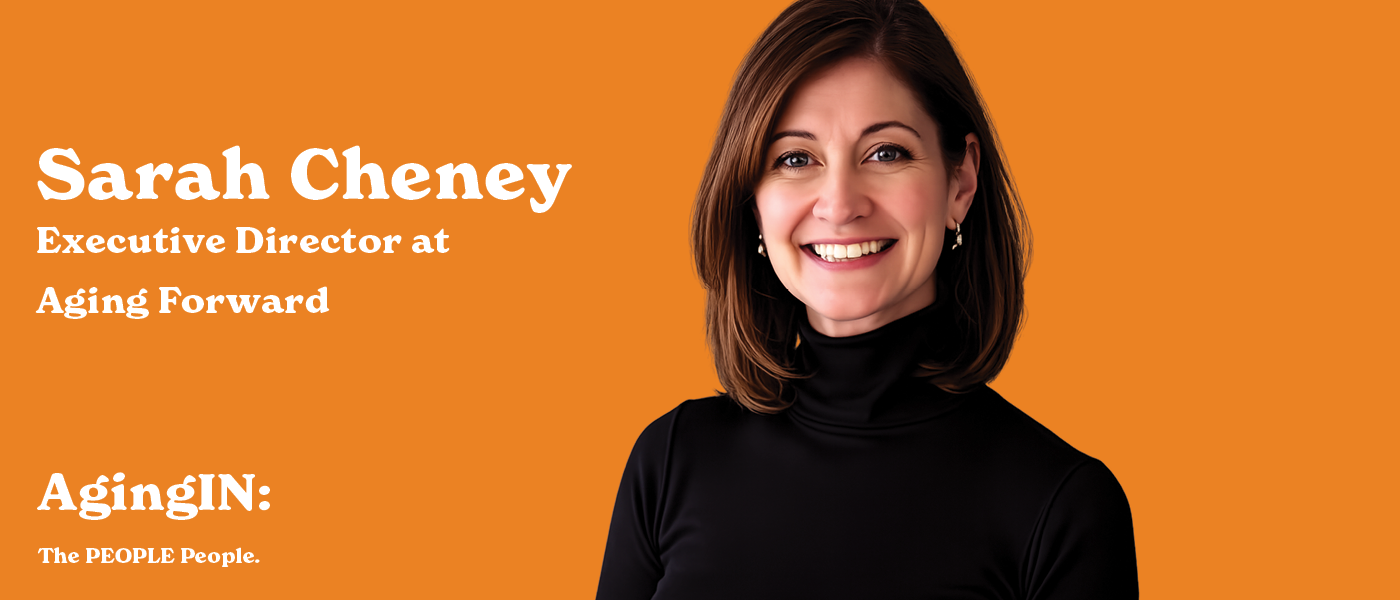
When Sarah Cheney was a child, she noticed something in her grandmother’s eyes every time the family packed up to leave. Her grandmother lived on a family farm six hours away, and the goodbyes always carried a silent heartache. Cheney once asked her mother why, and the answer stayed with her. Her grandmother was lonely, and the isolation set in the moment the family drove off.
Her mother showed her another angle of this stage of life. While raising a family and looking after Cheney’s grandmother, her mother built a full teaching career, and when she retired, she refused to stop growing and learning. She enrolled at Duke for a second master’s degree, taking the classes she had always dreamed of, and called it her “fun” degree.
Her grandmother showed Cheney what it costs to be cut off from connection, and her mother showed her what it looks like to stay rooted in purpose at every age. From these two examples, opposite in many ways, she learned that people deserve meaning and connection for as long as they live. That belief eventually led Cheney to Aging Forward, the national alliance she now leads as Executive Director, and it’s the mission that every part of the organization is built to serve.
A 50-Year-Old Idea That Still Works
Aging Forward began in 1972 as Shepherd’s Centers of America, founded by a Methodist minister named Elbert Cole. Members of his congregation kept telling him that retirement had not dimmed their desire to keep growing or their wish to give something back. A collaborative man by nature, Cole assembled an interfaith planning team that drew people from all walks of life, and together they spent a year shaping the model the organization still runs on. Two years later, he founded a national office to help other communities build their own.
Cole’s model is based on principles that emphasize independence, kindness and growth: empowerment and personal agency, neighbor helping neighbor, mutual respect, and a lifelong habit of learning and giving. Cole never required the communities he trained to adopt his name or stay in touch. He sent them off to do good work, and the work spread on its own across the country.
What Local Affiliates Actually Do
Each affiliate is locally rooted and locally owned, shaped to fit the community around it. The national office acts as a capacity builder while the affiliates run the programs that keep people connected and living in their own homes. Each alliance offers amenities that help community members thrive:
- Lifelong learning classes designed by and for older adults
- Volunteer transportation to medical appointments, the grocery store, and beyond
- Handy helper visits, from installing grab bars to raking leaves
- Friendly visiting and calling to ease isolation
What makes the model unique is that the people delivering these services are often older adults themselves, and they tend to say they get more from the experience than they give. The services are free, which keeps the spirit of neighbor helping neighbor intact. The alliance counts roughly 11,000 volunteers, whose donated hours add up to more than 13 million dollars in annual value, none of it billed to government or health systems.
Iris, and a Network That Travels
Another example that has stuck with Cheney is a woman named Iris. A doctor suggested tai chi to help Iris with her balance, and she found a class at an affiliate in San Diego and eventually started helping to teach. When she and her husband moved to Richmond, she called the local affiliate, hoping to enroll, but she learned they didn’t offer tai chi. She then volunteered to start a class herself and it filled to capacity in no time.
A later move brought the couple to St. Louis, as her husband began showing signs of brain change, and once again, Iris picked up the phone. This time, she needed rides to medical appointments; although her daughter lived nearby, she worked full time and Iris didn’t want to be a burden. The affiliate paired the couple with volunteers who carried them through the transition. Wherever life took her, an affiliate was waiting.
Better Together
The strength of the alliance shows up most clearly when one affiliate’s idea travels to another. Cheney recalled a tech tutoring program that began in St. Louis, where the team spent the better part of two years finding its footing. An affiliate in Virginia saw the presentation, adapted it, recruited college students as intergenerational volunteers, and launched its own version in four months. Cheney calls this the network multiplier effect, where one group works out the kinks so the next one doesn’t have to start from a blank slate.
That sharing is the whole point of the national gatherings, which Cole used to playfully call the “plagiarism pit.” The alliance keeps that spirit alive through several channels:
- Virtual webinars and small-group peer learning collaboratives
- Round tables where members bring a single challenge to solve together
- An online library of templates, policies, and best practices
- Regional clusters that meet to network and trade ideas
The Next 50 Years
In 2024, after half a century, the organization rebranded from Shepherd’s Centers to Aging Forward. The old name had served well, but affiliates were increasingly setting it aside, and Cheney wanted a bigger tent that could welcome lifelong learning and service programs alike. The new name also carries a feeling she likes, conveying momentum rather than decline.
Aging Forward currently has about 55 affiliates across 17 states, reaching roughly 165,000 older adults a year. Cheney wants to grow that to 200 thriving affiliates in all 50 states, connecting a million people annually. She knows the target is ambitious, but she believes the demographic need is plainly there, and that the volunteers and nonprofits willing to meet it are too. For Cheney, the larger purpose is to tell a more honest story about getting older, one that holds room for growth and contribution at every age.
“It’s not always about decline,” she explains. “There is opportunity for continued growth and contributing. Aging is part of our society, and aging is a good thing.”
Listen to the full conversation with Sarah Cheney on Elevate Eldercare, available on Spotify and Apple Podcasts.