
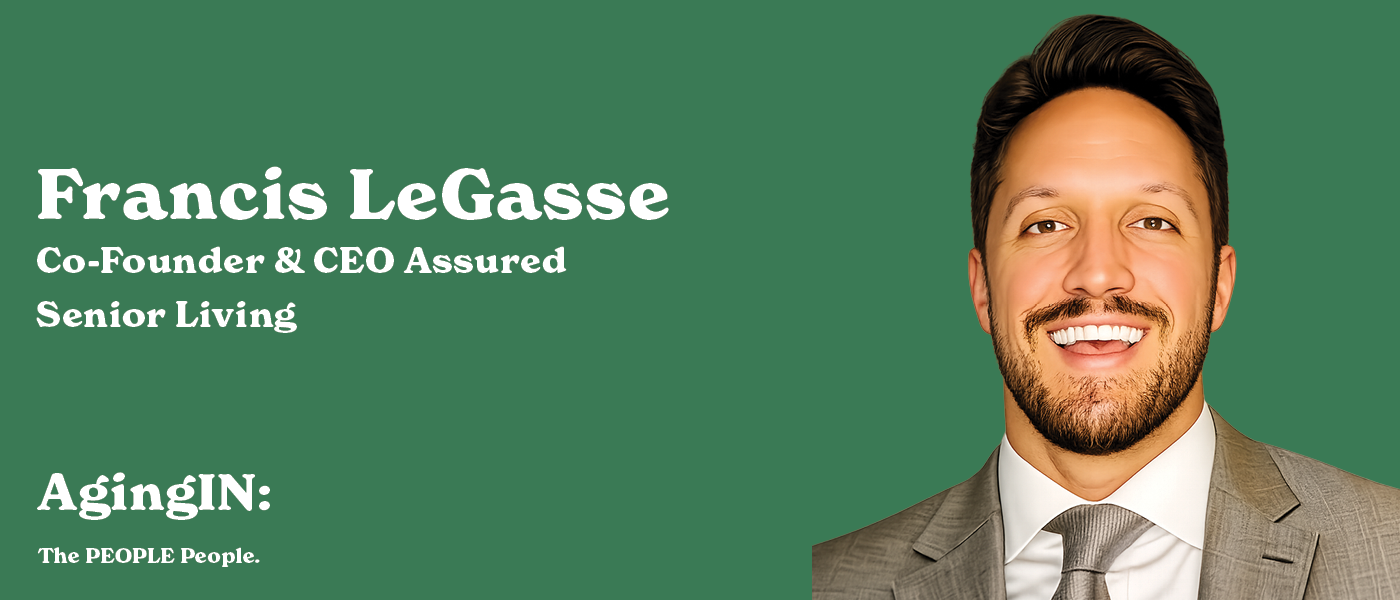
Francis LeGasse watched two grandfathers move through the aging experience in very different ways, and neither one sat right with him. His paternal grandfather lived with brain change that the family eventually traced to Agent Orange exposure during his military service. His maternal grandfather, a stoic and well-educated man who worked for General Motors past his 77th birthday, developed Parkinson’s and struggled to accept help from anyone (including his four-foot-eight inch Italian wife who adored him). A brief stay in a traditional institutional setting went awry. A catastrophic fall followed, leading to 58 days in a hospital he never left.
What lingered with LeGasse was not just the loss, but the way his grandfather felt through it all. “He almost felt like he was a burden,” LeGasse told Susan Ryan on a recent episode of Elevate Eldercare. “He still had, in my opinion, a lot of life to share and lead.”
That conviction became a company. In 2010, LeGasse and his college teammate Brian Turner launched a non-medical in-home services business in Colorado, learning what it takes to build trust inside someone’s own home. Families kept asking what came next when staying home was no longer workable, and the traditional options were exactly what the two of them had set out to avoid. In 2013, they opened a single, 12-bed residential home in Lakewood, a suburb of Denver. Today, Assured Senior Living operates 32 homes across the metro area, making it the largest residential provider of its kind in Colorado.
A House in a Neighborhood, on Purpose
Each home sits on an ordinary street, surrounded by single-family houses. From the outside, only an accessibility ramp hints at anything different. Inside, every design decision works toward the same goal that LeGasse traces back to his grandfather, who spent his final chapter feeling stuck. The aim is to increase freedom for people living with brain change without unnecessarily jeopardizing their safety, which includes:
- Seven to 12 residents per home, with two team members on duty during the day
- Short hallways instead of long corridors, so nothing feels far away
- Bedroom doors painted different colors, each with the resident’s photo displayed
- A kitchen and family-style dining room that function like those in every other home
- A secured backyard where residents can walk out on their own, with paths, shade, and a grill
- Neighborhood walks that spark memories of how residents lived in their own homes
The philosophy extends to the smallest routines. For residents who love to walk, the team cuts sandwiches into slices they can carry (because making someone sit still for lunch prioritizes the schedule rather than the person). Roughly half the rooms are shared, and LeGasse says the results have surprised him. Residents with roommates sleep better, wander less at night, and leave their rooms more often, drawn out by the simple example of another person doing the same.
Slowing Down as a Skill
The company staffs its homes so that team members can spend 15 to 20 minutes of one-on-one time with a resident every hour. LeGasse considers presence the actual work rather than a break from it. If a team member is sitting with a resident, holding hands and chatting, that is the job going well. The team is also trained in something counterintuitive: doing nothing. Stepping back, keeping eyes on a hard moment, and letting it settle can de-escalate a situation that eager helping would only amplify.
That patience matters even more in the nine homes dedicated to people living with brain injury, both traumatic and acquired. These residents are much younger, often in their 40s and 50s, and many arrive after months or years in hospitals, some having been on ventilators after accidents or strokes. For a 50-year-old man relearning daily routines, being allowed to try, struggle, and sometimes fail is a matter of dignity. The team’s instruction is simple: “You have the time to let them struggle.”
Nobody Gets Asked to Leave Over Money
Every home accepts Medicaid and the InnovAge PACE program, and when a private-pay resident spends down their savings, they stay put. LeGasse refuses to add financial fear during an already difficult time. His position on the broader question is “I truly believe every older adult, regardless of their socioeconomic status, deserves a very high level of base[line] aging care.” He is equally direct about the politics, noting that older adults tend to matter to lawmakers only until budgets are cut. He gives the example of Colorado’s Medicaid reimbursement dropping by two percent this July, even as the state’s aging population grows.
A Vision Built on Connection
LeGasse also helps lead AgeTech Colorado alongside founder Cambria Jacobs. They are working to connect technology builders, investors, providers, and the government so that solutions are tested against the real needs of aging services rather than what sounds impressive in a pitch deck. But his long-term vision runs deeper than any product. He imagines communities within communities, where the line between a traditional home and an aging home blurs into a seamless, connected way of living, where no one is defined by a diagnosis, a walker, or a label.
His final call to action is threefold:
- Get connected with your community and find your own way to serve
- Challenge the status quo (politely)
- Honor older adults by giving them the credit they have earned
“There is so much unsaid and said knowledge we can gain from our older adults about how they have lived their lives, and how they continue to live their lives, that if we all stopped for a moment and just watched and learned how they’ve handled struggles and happiness and sadness, we’d be a lot better off.”
Listen to the full conversation with Francis LeGasse on Elevate Eldercare, available on Spotify and Apple Podcasts.